Home
Tampilkan postingan dengan label Solar System. Tampilkan semua postingan

Asteroids

An asteroid is a minor planet of the inner Solar System. They are metallic or rocky bodies without atmospheres. The size and shapes of asteroids vary significantly, including even dwarf planets, but not planets.

Of the roughly one million known asteroids[1] the great number of them are located between the orbits of Mars and Jupiter, approximately 2 to 4 AU from the Sun, in the main asteroid belt. Asteroids are generally classified to be of three types: C-type, M-type, and S-type. These were named after and are generally identified with carbonaceous, metallic, and silicaceous compositions, respectively. The sizes of asteroids varies greatly; the largest, Ceres, is almost 1,000 km (600 mi) across and qualifies as a dwarf planet. The total mass of all the asteroids combined is less than that of Earth's Moon. The majority of main belt asteroids follow slightly elliptical, stable orbits, revolving in the same direction as the Earth and taking from three to six years to complete a full circuit of the Sun.[2]

Asteroids were historically observed from Earth; Galileo spacecraft was the first one to observe an asteroid from a small distance. After it, several dedicated missions to asteroids were launched by NASA and JAXA, and several missions are planned now. NASA's NEAR Shoemaker studied Eros, and Dawn observed Vesta and Ceres. JAXA's missions Hayabusa and Hayabusa2 studied and returned samples of Itokawa and Ryugu, respectively; NASA's OSIRIS-REx studied Bennu and would return a sample in 2023. Lucy, launched in 2021 would visit eight different asteroids, one from the main belt and seven Jupiter trojans. Psyche would be launched in August 2022, and would study asteroid of the same name in 2026.

Near-Earth asteroids can threaten all life on the planet; an asteroid impact event resulted in the Cretaceous–Paleogene extinction. Different asteroid deflection strategies were proposed; Double Asteroid Redirection Test was launched in 2021 and is currently underway to Dimorphos, and would attempt to alter the asteroid's orbit by crashing into it in September 2022.

Comets

A comet is an icy, small Solar System body that, when passing close to the Sun, warms and begins to release gases, a process that is called outgassing. This produces a visible atmosphere or coma, and sometimes also a tail. These phenomena are due to the effects of solar radiation and the solar wind acting upon the nucleus of the comet. Comet nuclei range from a few hundred meters to tens of kilometers across and are composed of loose collections of ice, dust, and small rocky particles. The coma may be up to 15 times Earth's diameter, while the tail may stretch beyond one astronomical unit. If sufficiently bright, a comet may be seen from Earth without the aid of a telescope and may subtend an arc of 30° (60 Moons) across the sky. Comets have been observed and recorded since ancient times by many cultures and religions.

Comets usually have highly eccentric elliptical orbits, and they have a wide range of orbital periods, ranging from several years to potentially several millions of years. Short-period comets originate in the Kuiper belt or its associated scattered disc, which lie beyond the orbit of Neptune. Long-period comets are thought to originate in the Oort cloud, a spherical cloud of icy bodies extending from outside the Kuiper belt to halfway to the nearest star. Long-period comets are set in motion towards the Sun from the Oort cloud by gravitational perturbations caused by passing stars and the galactic tide. Hyperbolic comets may pass once through the inner Solar System before being flung to interstellar space. The appearance of a comet is called an apparition.

Comets are distinguished from asteroids by the presence of an extended, gravitationally unbound atmosphere surrounding their central nucleus. This atmosphere has parts termed the coma (the central part immediately surrounding the nucleus) and the tail (a typically linear section consisting of dust or gas blown out from the coma by the Sun's light pressure or outstreaming solar wind plasma). However, extinct comets that have passed close to the Sun many times have lost nearly all of their volatile ices and dust and may come to resemble small asteroids. Asteroids are thought to have a different origin from comets, having formed inside the orbit of Jupiter rather than in the outer Solar System.The discovery of main-belt comets and active centaur minor planets has blurred the distinction between asteroids and comets. In the early 21st century, the discovery of some minor bodies with long-period comet orbits, but characteristics of inner solar system asteroids, were called Manx comets. They are still classified as comets, such as C/2014 S3 (PANSTARRS).27 Manx comets were found from 2013 to 2017.

As of November 2021 there are 4584 known comets.However, this represents only a tiny fraction of the total potential comet population, as the reservoir of comet-like bodies in the outer Solar System (in the Oort cloud) is estimated to be one trillion. Roughly one comet per year is visible to the naked eye, though many of those are faint and unspectacular.Particularly bright examples are called "great comets". Comets have been visited by unmanned probes such as the European Space Agency's Rosetta, which became the first to land a robotic spacecraft on a comet, and NASA's Deep Impact, which blasted a crater on Comet Tempel 1 to study its interior.

Trans-Neptunian

A trans-Neptunian object (TNO), also written transneptunian object, is any minor planet in the Solar System that orbits the Sun at a greater average distance than Neptune, which has a semi-major axis of 30.1 astronomical units (AU).

Typically, TNOs are further divided into the classical and resonant objects of the Kuiper belt, the scattered disc and detached objects with the sednoids being the most distant ones.[nb 1] As of October 2020, the catalog of minor planets contains 678 numbered and more than 2,000 unnumbered TNOs.

The first trans-Neptunian object to be discovered was Pluto in 1930. It took until 1992 to discover a second trans-Neptunian object orbiting the Sun directly, 15760 Albion. The most massive TNO known is Eris, followed by Pluto, Haumea, Makemake, and Gonggong. More than 80 satellites have been discovered in orbit of trans-Neptunian objects. TNOs vary in color and are either grey-blue (BB) or very red (RR). They are thought to be composed of mixtures of rock, amorphous carbon and volatile ices such as water and methane, coated with tholins and other organic compounds.

Twelve minor planets with a semi-major axis greater than 150 AU and perihelion greater than 30 AU are known, which are called extreme trans-Neptunian objects (ETNOs).

Neptune

Neptune is the eighth and farthest-known Solar planet from the Sun. In the Solar System, it is the fourth-largest planet by diameter, the third-most-massive planet, and the densest giant planet. It is 17 times the mass of Earth, and slightly more massive than its near-twin Uranus. Neptune is denser and physically smaller than Uranus because its greater mass causes more gravitational compression of its atmosphere. It is referred to as one of the solar system's two ice giant planets (the other one being its near-twin Uranus).

Being composed primarily of gases and liquids, it has no well-defined "solid surface." The planet orbits the Sun once every 164.8 years at an average distance of 30.1 AU (4.5 billion km; 2.8 billion mi). It is named after the Roman god of the sea and has the astronomical symbol ♆, representing Neptune's trident.

Neptune is not visible to the unaided eye and is the only planet in the Solar System found by mathematical prediction rather than by empirical observation. Unexpected changes in the orbit of Uranus led Alexis Bouvard to hypothesise that its orbit was subject to gravitational perturbation by an unknown planet. After Bouvard's death, the position of Neptune was predicted from his observations, independently, by John Couch Adams and Urbain Le Verrier. Neptune was subsequently observed with a telescope on 23 September 1846 by Johann Galle within a degree of the position predicted by Le Verrier. Its largest moon, Triton, was discovered shortly thereafter, though none of the planet's remaining 13 known moons were located telescopically until the 20th century. The planet's distance from Earth gives it a very small apparent size, making it challenging to study with Earth-based telescopes. Neptune was visited by Voyager 2, when it flew by the planet on 25 August 1989; Voyager 2 remains the only spacecraft to have visited Neptune. The advent of the Hubble Space Telescope and large ground-based telescopes with adaptive optics has recently allowed for additional detailed observations from afar.

Like Jupiter and Saturn, Neptune's atmosphere is composed primarily of hydrogen and helium, along with traces of hydrocarbons and possibly nitrogen, though it contains a higher proportion of "ices" such as water, ammonia and methane. However, similar to Uranus, its interior is primarily composed of ices and rock; Uranus and Neptune are normally considered "ice giants" to emphasise this distinction. Traces of methane in the outermost regions in part account for the planet's blue appearance, though an unknown component is believed to color Neptune a deeper blue compared to Uranus.

In contrast to the hazy, relatively featureless atmosphere of Uranus, Neptune's atmosphere has active and visible weather patterns. For example, at the time of the Voyager 2 flyby in 1989, the planet's southern hemisphere had a Great Dark Spot comparable to the Great Red Spot on Jupiter. More recently, in 2018, a newer main dark spot and smaller dark spot were identified and studied. In addition, these weather patterns are driven by the strongest sustained winds of any planet in the Solar System, with recorded wind speeds as high as 2,100 km/h (580 m/s; 1,300 mph). Because of its great distance from the Sun, Neptune's outer atmosphere is one of the coldest places in the Solar System, with temperatures at its cloud tops approaching 55 K (−218 °C; −361 °F). Temperatures at the planet's centre are approximately 5,400 K (5,100 °C; 9,300 °F). Neptune has a faint and fragmented ring system (labelled "arcs"), which was discovered in 1984, then later confirmed by Voyager 2.

Uranus

Uranus is the seventh planet from the Sun. Its name is a reference to the Greek god of the sky, Uranus, who, according to Greek mythology, was the great-grandfather of Ares (Mars), grandfather of Zeus (Jupiter) and father of Cronus (Saturn). It has the third-largest planetary radius and fourth-largest planetary mass in the Solar System. Uranus is similar in composition to Neptune, and both have bulk chemical compositions which differ from that of the larger gas giants Jupiter and Saturn. For this reason, scientists often classify Uranus and Neptune as "ice giants" to distinguish them from the other giant planets.

As with gas giants, ice giants also lack a well defined "solid surface." Uranus's atmosphere is similar to Jupiter's and Saturn's in its primary composition of hydrogen and helium, but it contains more "ices" such as water, ammonia, and methane, along with traces of other hydrocarbons. It has the coldest planetary atmosphere in the Solar System, with a minimum temperature of 49 K (−224 °C; −371 °F), and has a complex, layered cloud structure with water thought to make up the lowest clouds and methane the uppermost layer of clouds.The interior of Uranus is mainly composed of ices and rock.

Like the other giant planets, Uranus has a ring system, a magnetosphere, and numerous moons. The Uranian system has a unique configuration because its axis of rotation is tilted sideways, nearly into the plane of its solar orbit. Its north and south poles, therefore, lie where most other planets have their equators.In 1986, images from Voyager 2 showed Uranus as an almost featureless planet in visible light, without the cloud bands or storms associated with the other giant planets. Voyager 2 remains the only spacecraft to visit the planet. Observations from Earth have shown seasonal change and increased weather activity as Uranus approached its equinox in 2007. Wind speeds can reach 250 metres per second (900 km/h; 560 mph).

Saturn

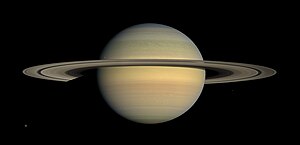
Saturn is the sixth planet from the Sun and the second-largest in the Solar System, after Jupiter. It is a gas giant with an average radius of about nine and a half times that of Earth. It has only one-eighth the average density of Earth; however, with its larger volume, Saturn is over 95 times more massive.

Saturn's interior is most likely composed of a core of iron–nickel and rock (silicon and oxygen compounds). Its core is surrounded by a deep layer of metallic hydrogen, an intermediate layer of liquid hydrogen and liquid helium, and finally, a gaseous outer layer. Saturn has a pale yellow hue due to ammonia crystals in its upper atmosphere. An electrical current within the metallic hydrogen layer is thought to give rise to Saturn's planetary magnetic field, which is weaker than Earth's, but which has a magnetic moment 580 times that of Earth due to Saturn's larger size. Saturn's magnetic field strength is around one-twentieth of Jupiter's. The outer atmosphere is generally bland and lacking in contrast, although long-lived features can appear. Wind speeds on Saturn can reach 1,800 km/h (1,100 mph; 500 m/s), higher than on Jupiter but not as high as on Neptune.

The planet's most notable feature is its prominent ring system, which is composed mainly of ice particles, with a smaller amount of rocky debris and dust. At least 83 moons are known to orbit Saturn, of which 53 are officially named; this does not include the hundreds of moonlets in its rings. Titan, Saturn's largest moon and the second largest in the Solar System, is larger than the planet Mercury, although less massive, and is the only moon in the Solar System to have a substantial atmosphere.

Jupiter

Jupiter is the fifth planet from the Sun and the largest in the Solar System. It is a gas giant with a mass more than two and a half times that of all the other planets in the Solar System combined, but slightly less than one-thousandth the mass of the Sun. Jupiter is the third brightest natural object in the Earth's night sky after the Moon and Venus, and it has been observed since prehistoric times. It was named after the Roman god Jupiter, the king of the gods.

Jupiter is primarily composed of hydrogen, but helium constitutes one-quarter of its mass and one-tenth of its volume. It probably has a rocky core of heavier elements, but, like the other giant planets in the Solar System, it lacks a well-defined solid surface. The ongoing contraction of Jupiter's interior generates more heat than it receives from the Sun. Because of its rapid rotation, the planet's shape is an oblate spheroid: it has a slight but noticeable bulge around the equator. The outer atmosphere is divided into a series of latitudinal bands, with turbulence and storms along their interacting boundaries. A prominent result of this is the Great Red Spot, a giant storm which has been observed since at least 1831.

Jupiter is surrounded by a faint planetary ring system and a powerful magnetosphere. Jupiter's magnetic tail is nearly 800 million km (5.3 AU; 500 million mi) long, covering nearly the entire distance to Saturn's orbit. Jupiter has 80 known moons and possibly many more, including the four large moons discovered by Galileo Galilei in 1610: Io, Europa, Ganymede, and Callisto. Io and Europa are about the size of Earth's Moon; Callisto is almost the size of the planet Mercury, and Ganymede is larger.

Pioneer 10 was the first spacecraft to visit Jupiter, making its closest approach to the planet in December 1973. Jupiter has since been explored by multiple robotic spacecraft, beginning with the Pioneer and Voyager flyby missions from 1973 to 1979, and later with the Galileo orbiter in 1995. In 2007, the New Horizons visited Jupiter using its gravity to increase its speed, bending its trajectory en route to Pluto. The latest probe to visit the planet, Juno, entered orbit around Jupiter in July 2016. Future targets for exploration in the Jupiter system include the probable ice-covered liquid ocean of Europa.

Mars

Mars is the fourth planet from the Sun and the second-smallest planet in the Solar System, being larger than only Mercury. In English, Mars carries the name of the Roman god of war. Mars is a terrestrial planet with a thin atmosphere, and has a crust primarily composed of elements similar to Earth's crust, as well as a core made of iron and nickel. Mars has surface features such as impact craters, valleys, dunes, and polar ice caps. It also has two small and irregularly shaped moons, Phobos and Deimos.

Some of the most notable surface features on Mars include features such as Olympus Mons, the largest volcano and highest known mountain on any Solar System planet, and Valles Marineris, one of the largest canyons in the Solar System. The smooth Borealis basin in the Northern Hemisphere covers 40% of the planet and may be a giant impact feature. The days and seasons on Mars are comparable to those of Earth as the planets have a similar rotation period and tilt of the rotational axis relative to the ecliptic plane. Liquid water on the surface of Mars cannot exist due to low atmospheric pressure, which is less than 1% of the atmospheric pressure on Earth. Both of Mars's polar ice caps appear to be made largely of water. Multiple lines of evidence suggest that Mars was wetter in the distant past, and thus possibly more suited for life. However, whether life ever did exist there, and if it could have survived to the present day, remain unanswered questions.

Mars has been explored by several uncrewed spacecraft, beginning with Mariner 4 in 1965. NASA's Viking 1 lander transmitted the first images from the Martian surface in 1976. Two countries have successfully deployed rovers on Mars, the United States first doing so with Sojourner in 1997 and China with Zhurong in 2021. There are also planned future missions to Mars, such as a Mars sample-return mission set to happen in 2026, and the Rosalind Franklin rover mission, which was intended to launch in 2018 but was delayed to 2024.

Mars can easily be seen from Earth with the naked eye, as can its striking reddish coloring. This appearance, due the iron oxide prevalent on its surface, has led to Mars often being called the Red Planet. It is among the brightest objects in Earth's sky, with an apparent magnitude that reaches −2.94, comparable to that of Jupiter and surpassed only by Venus, the Moon and the Sun. Historically, Mars has been observed since ancient times, and over the centuries, has been featured in culture and the arts in ways that have reflected humanity's growing knowledge of it.

Earth

Earth is the third planet from the Sun and the only astronomical object known to harbor life. While large volumes of water can be found throughout the Solar System, only Earth sustains liquid surface water. About 71% of Earth's surface is made up of the ocean, dwarfing Earth's polar ice, lakes, and rivers. The remaining 29% of Earth's surface is land, consisting of continents and islands. Earth's surface layer is formed of several slowly moving tectonic plates, interacting to produce mountain ranges, volcanoes, and earthquakes. Earth's liquid outer core generates the magnetic field that shapes Earth's magnetosphere, deflecting destructive solar winds.

Earth's atmosphere consists mostly of nitrogen and oxygen. More solar energy is received by tropical regions than polar regions and is redistributed by atmospheric and ocean circulation. Water vapor is widely present in the atmosphere and forms clouds that cover most of the planet. Greenhouse gases in the atmosphere like carbon dioxide (CO2) trap a part of the energy from the Sun close to the surface. A region's climate is governed by latitude, but also by elevation and proximity to moderating oceans. Severe weather, such as tropical cyclones, thunderstorms, and heatwaves, occurs in most areas and greatly impacts life.

Earth is an ellipsoid with a circumference of about 40,000 km. It is the densest planet in the Solar System. Of the four rocky planets, it is the largest and most massive. Earth is about eight light minutes away from the Sun and orbits it, taking a year (about 365.25 days) to complete one revolution. Earth rotates around its own axis in just less than a day (in about 23 hours and 56 minutes). Earth's axis of rotation is tilted with respect to the perpendicular to its orbital plane around the Sun, producing seasons. Earth is orbited by one permanent natural satellite, the Moon, which orbits Earth at 380,000 km (1.3 light seconds) and is roughly a quarter as wide as Earth. The Moon always faces the Earth with the same side through tidal locking and causes tides, stabilizes Earth's axis, and gradually slows its rotation.

Earth formed over 4.5 billion years ago. During the first billion years of Earth's history, the ocean formed and then life developed within it. Life spread globally and began to affect Earth's atmosphere and surface, leading to Earth's Great Oxidation Event two billion years ago. Humans emerged 300,000 years ago, and have reached a population of almost 8 billion today. Humans depend on Earth's biosphere and natural resources for their survival, but have increasingly impacted Earth's environment. Today, humanity's impact on Earth's climate, soils, waters, and ecosystems is unsustainable, threatening people's lives and causing widespread extinction of other life.

Venus

Venus is the second planet from the Sun and is named after the Roman goddess of love and beauty. As the brightest natural object in Earth's night sky after the Moon, Venus can cast shadows and can be visible to the naked eye in broad daylight. Venus's orbit is smaller than that of Earth, but its maximal elongation is 47°; thus, at latitudes with a day-night cycle, it is most readily visible for up to a few hours following the start of sunset or before sunrise. At times, it has been seen in a completely dark sky. Venus orbits the Sun every 224.7 Earth days. It has a synodic day length of 117 Earth days and a sidereal rotation period of 243 Earth days. Consequently, it takes longer to rotate about its axis than any other planet in the Solar System, and does so in the opposite direction to all but Uranus. This means that the Sun rises from its western horizon and sets in its east. Venus does not have any moons, a distinction it shares only with Mercury among the planets in the Solar System.

The third smallest planet in the Solar System, Venus is a terrestrial planet and is sometimes called Earth's "sister planet" because of their similar size, mass, proximity to the Sun, and bulk composition. It is radically different from Earth in other respects. It has the densest atmosphere of the four terrestrial planets, consisting of more than 96% carbon dioxide. The atmospheric pressure at the planet's surface is about 92 times the sea level pressure of Earth, or roughly the pressure at 900 m (3,000 ft) underwater on Earth. Even though Mercury is closer to the Sun, Venus has the hottest surface of any planet in the Solar System, with a mean temperature of 737 K (464 °C; 867 °F). Venus is shrouded by an opaque layer of highly reflective clouds of sulfuric acid, preventing its surface from being seen from space in light. It may have had water oceans in the past, but after these evaporated the temperature rose under a runaway greenhouse effect. The water has probably photodissociated, and the free hydrogen has been swept into interplanetary space by the solar wind because of the lack of a planetary magnetic field Because of the lethal surface conditions, the planet is sometimes referred to as Earth's "evil twin".

As one of the brightest objects in the sky, Venus has been a major fixture in human culture for as long as records have existed. It has been made sacred to gods of many cultures and has been a prime inspiration for writers and poets as the "morning star" and "evening star". Venus was the first planet to have its motions plotted across the sky, as early as the second millennium BCE.

Its proximity to Earth has made Venus a prime target for early interplanetary exploration. It was the first planet beyond Earth visited by a spacecraft (Venera 1 in 1961) and the first to be successfully landed on (by Venera 7 in 1970). The planet's thick clouds render observation of its surface impossible in the visible spectrum, and the first detailed maps did not emerge until the arrival of the Magellan orbiter in 1991. Plans have been proposed for rovers or more complex missions, but they are hindered by Venus's hostile surface conditions. The possibility of life on Venus has long been a topic of speculation; in recent years, the topic has received active research.

Mercury

Mercury is the smallest planet in the Solar System and the closest to the Sun. Its orbit around the Sun takes 87.97 Earth days, the shortest of all the Sun's planets. It is named after the Roman god Mercurius (Mercury), god of commerce, messenger of the gods, and mediator between gods and mortals, corresponding to the Greek god Hermes (Ἑρμῆς). Like Venus, Mercury orbits the Sun within Earth's orbit as an inferior planet, and its apparent distance from the Sun as viewed from Earth never exceeds 28°. This proximity to the Sun means the planet can only be seen near the western horizon after sunset or the eastern horizon before sunrise, usually in twilight. At this time, it may appear as a bright star-like object, but is more difficult to observe than Venus. From Earth, the planet telescopically displays the complete range of phases, similar to Venus and the Moon, which recurs over its synodic period of approximately 116 days.

Mercury rotates in a way that is unique in the Solar System. It is tidally locked with the Sun in a 3:2 spin–orbit resonance, meaning that relative to the fixed stars, it rotates on its axis exactly three times for every two revolutions it makes around the Sun. As seen from the Sun, in a frame of reference that rotates with the orbital motion, it appears to rotate only once every two Mercurian years. An observer on Mercury would therefore see only one day every two Mercurian years.

Mercury's axis has the smallest tilt of any of the Solar System's planets (about 1⁄30 degree). Its orbital eccentricity is the largest of all known planets in the Solar System; at perihelion, Mercury's distance from the Sun is only about two-thirds (or 66%) of its distance at aphelion. Mercury's surface appears heavily cratered and is similar in appearance to the Moon's, indicating that it has been geologically inactive for billions of years. Having almost no atmosphere to retain heat, it has surface temperatures that vary diurnally more than on any other planet in the Solar System, ranging from 100 K (−173 °C; −280 °F) at night to 700 K (427 °C; 800 °F) during the day across the equatorial regions. The polar regions are constantly below 180 K (−93 °C; −136 °F). The planet has no known natural satellites.

Two spacecraft have visited Mercury: Mariner 10 flew by in 1974 and 1975; and MESSENGER, launched in 2004, orbited Mercury over 4,000 times in four years before exhausting its fuel and crashing into the planet's surface on April 30, 2015. The BepiColombo spacecraft is planned to arrive at Mercury in 2025.

Sun


The Sun is the star at the center of the Solar System. It is a nearly perfect ball of hot plasma, heated to incandescence by nuclear fusion reactions in its core, radiating the energy mainly as visible light, ultraviolet light, and infrared radiation. It is by far the most important source of energy for life on Earth. 

Its diameter is about 1.39 million kilometers (864,000 miles), or 109 times that of Earth. Its mass is about 330,000 times that of Earth, and it accounts for about 99.86% of the total mass of the Solar System. Roughly three quarters of the Sun's mass consists of hydrogen (~73%); the rest is mostly helium (~25%), with much smaller quantities of heavier elements, including oxygen, carbon, neon and iron.

    According to its spectral class, the Sun is a G-type main-sequence star (G2V). As such, it is informally, and not completely accurately, referred to as a yellow dwarf (its light is closer to white than yellow). It formed approximately 4.6 billion years ago from the gravitational collapse of matter within a region of a large molecular cloud. 

Most of this matter gathered in the center, whereas the rest flattened into an orbiting disk that became the Solar System. The central mass became so hot and dense that it eventually initiated nuclear fusion in its core. It is thought that almost all stars form by this process.

    Every second, the Sun's core fuses about 600 million tons of hydrogen into helium, and in the process converts 4 million tons of matter into energy. This energy, which can take between 10,000 and 170,000 years to escape the core, is the source of the Sun's light and heat. 

When hydrogen fusion in its core has diminished to the point at which the Sun is no longer in hydrostatic equilibrium, its core will undergo a marked increase in density and temperature while its outer layers expand, eventually transforming the Sun into a red giant. It is calculated that the Sun will become sufficiently large to engulf the current orbits of Mercury and Venus, and render Earth uninhabitable – but not for about five billion years. 

After this, it will shed its outer layers and become a dense type of cooling star known as a white dwarf, and no longer produce energy by fusion, but still glow and give off heat from its previous fusion.

    The enormous effect of the Sun on Earth has been recognized since prehistoric times. The Sun was thought of by some cultures as a deity. The synodic rotation of Earth and its orbit around the Sun are the basis of some solar calendars. The predominant calendar in use today is the Gregorian calendar which is based upon the standard 16th-century interpretation that the Sun's observed movement is primarily due to it actually moving.

NamesSun, Sol /ˈsɒl/,[1] SólHelios /ˈhliəs/[2]
AdjectivesSolar /ˈslər/[3]
Observation data
Mean distance
from Earth
AU ≈ 1.496×10⁸ km[4]
8 min 19 s at light speed
Visual brightness (V)−26.74[5]
Absolute magnitude4.83[5]
Spectral classificationG2V[6]
MetallicityZ = 0.0122[7]
Angular size31.6–32.7 minutes of arc[8]
0.527–0.545 degrees
Orbital characteristics
Mean distance
from Milky Way core
≈ 2.7×10¹⁷ km
≈ 29,000 light-years
Galactic period(2.25–2.50)×108 yr
Velocity≈ 251 km/s (orbit around the center of the Milky Way)
≈ 20 km/s (relative to average velocity of other stars in stellar neighborhood)
≈ 370 km/s[9] (relative to the cosmic microwave background)
Physical characteristics
Equatorial radius695,700 km,[10]
696,342 km[11]
109 × Earth radii[12]
Equatorial circumference4.379×106 km[12]
109 × Earth[12]
Flattening9×10−6
Surface area6.09×1012 km2[12]
12,000 × Earth[12]
Volume1.41×1018 km3[12]
1,300,000 × Earth
Mass1.9885×1030 kg[5]
332,950 Earths[5]
Average density1.408 g/cm3[5][12][13]
0.255 × Earth[5][12]
Center density (modeled)162.2 g/cm3[5]
12.4 × Earth
Equatorial surface gravity274 m/s2[5]
28 × Earth[12]
Moment of inertia factor0.070[5] (estimate)
Escape velocity
(from the surface)
617.7 km/s[12]
55 × Earth[12]
TemperatureCenter (modeled): 1.57×10⁷ K[5]
Photosphere (effective): 5,772 K[5]
Corona: ≈ 5×10⁶ K
Luminosity (Lsol)3.828×1026 W[5]
≈ 3.75×1028 lm
≈ 98 lm/W efficacy
Color (B-V)0.63
Mean radiance (Isol)2.009×10⁷ W·m−2·sr−1
Age≈ 4.6 billion years (4.6×10⁹ years[14][15]
Rotation characteristics
Obliquity7.25°[5]
(to the ecliptic)
67.23°
(to the galactic plane)
Right ascension
of North pole[16]
286.13°
19 h 4 min 30 s
Declination
of North pole
+63.87°
63° 52' North
Sidereal rotation period
(at equator)
25.05 d[5]
(at 16° latitude)25.38 d[5]
25 d 9 h 7 min 12 s[16]
(at poles)34.4 d[5]
Rotation velocity
(at equator)
1.997 km/s[12]
Photospheric composition (by mass)
Hydrogen73.46%[17]
Helium24.85%
Oxygen0.77%
Carbon0.29%
Iron0.16%
Neon0.12%
Nitrogen0.09%
Silicon0.07%
Magnesium0.05%
Sulphur0.04%